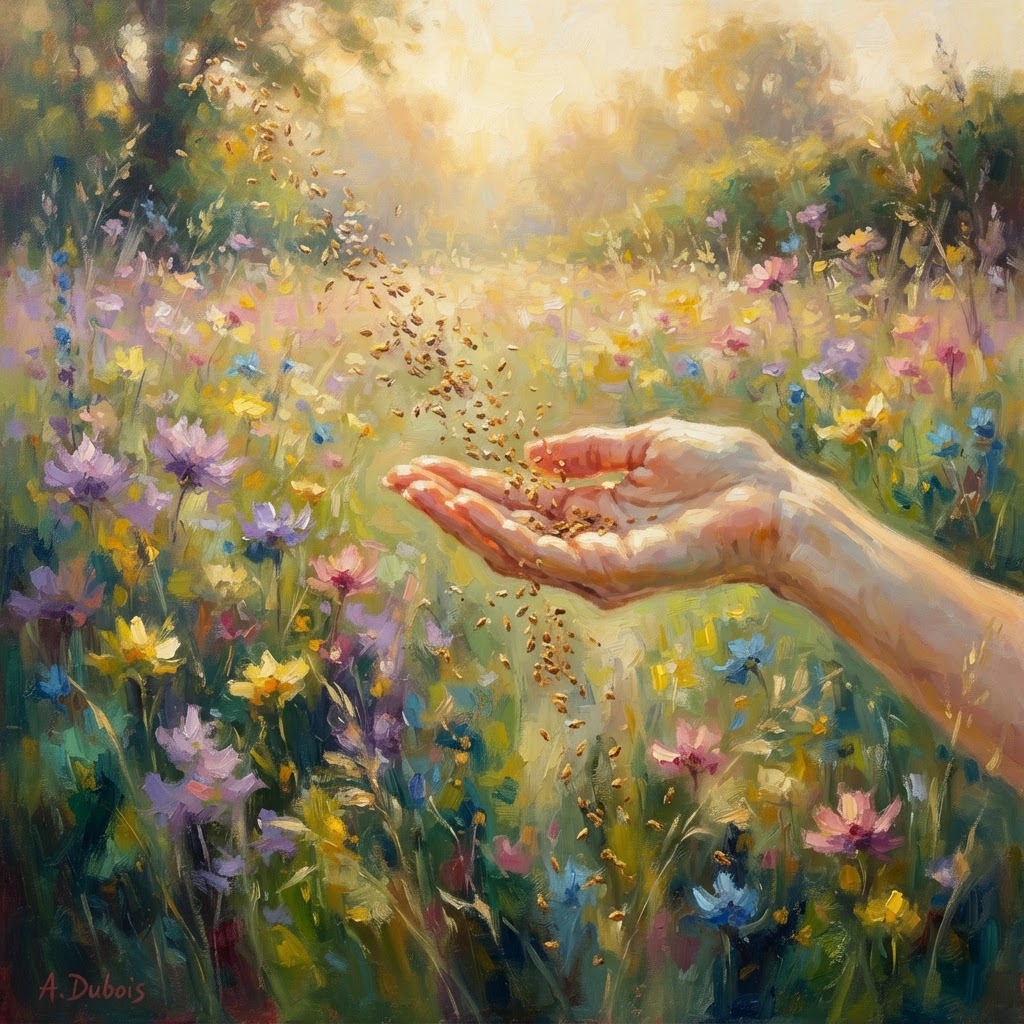
The Open Hand: Finding Abundance in the Architecture of Decay
To hold a cup too tightly is to eventually bruise the hand that grips it; to fear the spilling of water is to miss the beauty of the rain. We often mistake the finite nature of our possessions for a scarcity of life itself, yet it is precisely the impermanence of all things that grants them their value. Our modern obsession with accumulation is not a search for security, but a frantic attempt to negotiate with a gravity we cannot defeat. Consider the architecture of the modern attention economy, a system built entirely on the engineering of scarcity. Corporations do not merely sell products; they manufacture 'not enough' as a psychological state. By curating social feeds that emphasize FOMO—the fear of missing out—the attention economy creates a digital famine where the user feels perpetually behind, under-represented, and incomplete. This is a deliberate, algorithmic extraction of our presence, fueled by the lie that if we aren't constantly consuming, engaging, or signaling, we are ceasing to exist. The scarcity worldview posits that human satisfaction is a zero-sum game, leading to the burnout culture that defines our current era. If we shift the lens from scarcity to abundance, the cure for this digital famine is not 'more' content, but the practice of 'enough.' When we recognize that our internal worth is not tied to the flickering stream of data, the structural demand for constant consumption dissolves. Abundance is not a surplus of external goods; it is the realization that we are not lacking. By practicing Santosha—the cultivation of contentment—we stop trying to fill a hollow space with temporary inputs. We begin to see that the digital space is a medium for connection rather than a yardstick for comparison. From the dharma perspective, we look toward Shunyata, or emptiness, which is not a void of absence, but a void of infinite possibility. Because all things are empty of inherent, permanent substance, they are also empty of the power to define our happiness. This understanding is the gateway to Dana, the practice of radical generosity. When we realize that we cannot hold onto anything, the instinct to hoard gives way to the impulse to share. The stream of life flows through us rather than stopping at us. This week, try a 'Notice the Grip' inquiry. Whenever you feel the urge to refresh your feed, buy a redundant item, or hoard a resource out of fear that it might run out, pause. Place your hand on your heart and ask: 'What am I afraid will happen if I allow this to be enough?' Sit with the discomfort of that question for three mindful breaths before acting. We invite you to hold this inquiry not as a task to be completed, but as a lens to polish. In our shared life at The Beacon, we are not looking for the end of the conversation, but for a deeper seat in the middle of it. How does it change your morning, your work, or your relationships to view every passing moment as a gift of abundance rather than a sliver of time lost?