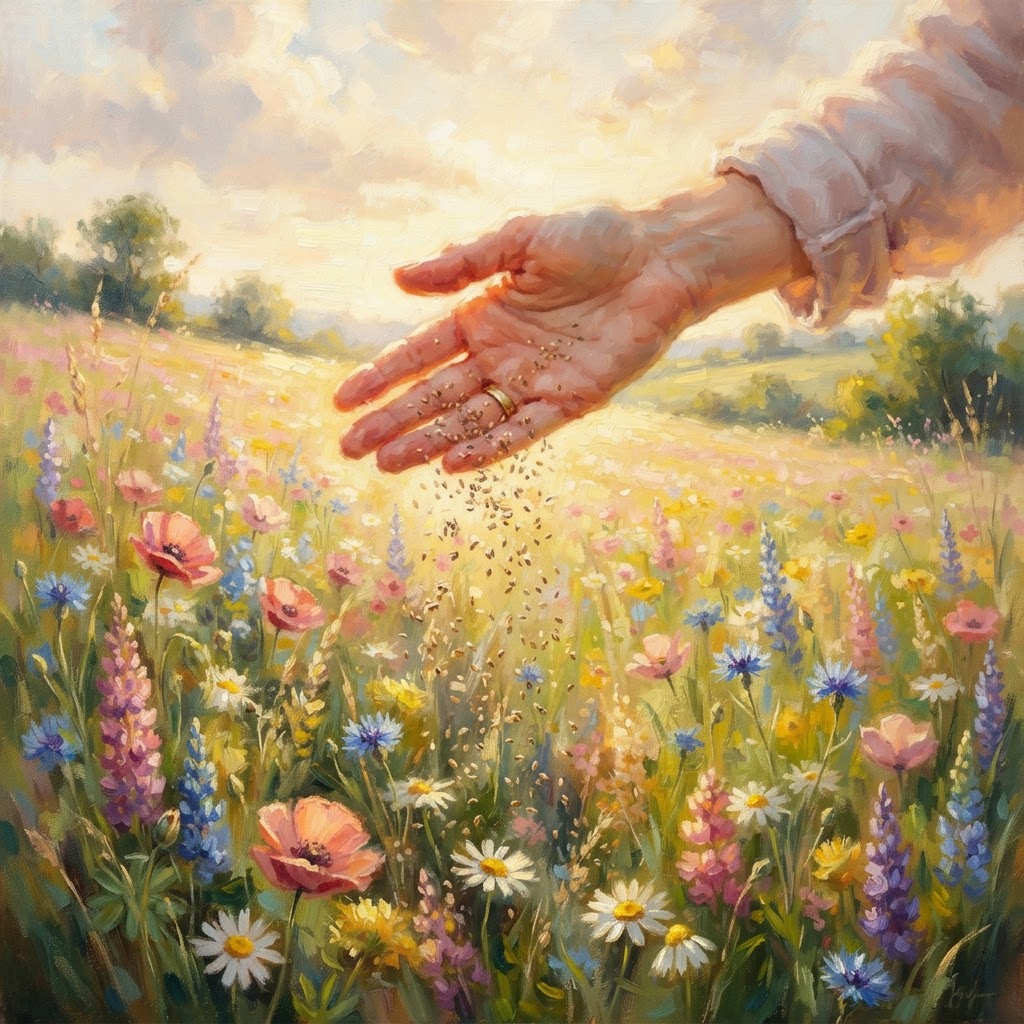
The Open Hand: Wealth in the Shadow of Impermanence
To hold a handful of water is to invite its disappearance; to leave the palm open is to allow the stream to remain a stream. We suffer not because the world is empty, but because we mistake the stillness of an object for the truth of its duration. In our modern landscape, this fundamental misunderstanding manifests most clearly in the 'Attention Economy.' We live in a society structured around the assumption that human focus is a finite, scarce commodity that must be mined, captured, and commodified. Platforms are designed to trigger our evolutionary hunger for 'more'—more likes, more news, more validation—treating every waking second as a resource to be extracted. This is the ultimate expression of the scarcity worldview: the belief that if I am not seizing your attention, I am losing my place in the world. Our screens have become theaters of hoarding, where we stockpile 'relevance' to stave off the phantom of irrelevance, driven by the frantic, hollow conviction that there is never enough time or enough status to go around.
When we apply the lens of abundance, the structure of this digital hunger collapses. Abundance is not a surplus of inputs; it is the recognition that attention is a participatory act of relationship, not a resource to be consumed. If we view the other not as a competitor for a limited pool of attention, but as a co-creator in a vast, interconnected field, the need to hoard vanishes. 'Enough' becomes a radical act of slowing down. When we operate from the knowledge that we are already part of a whole, the pressure to extract drops away. We stop trying to store life in a digital silo and begin to inhabit the present moment, which is inherently inexhaustible because it is constantly being reborn.
This is the secret that impermanence teaches us: because nothing lasts, nothing can be trapped. In the dharma, we speak of Shunyata, or emptiness, not as a void, but as an infinite capacity for things to arise. When we embrace that all phenomena are empty of a permanent, separate 'self' that needs defending, we find that our internal resources are not fixed or limited. We move toward Santosha, or contentment, not because we have satisfied every desire, but because we have realized that the desire for 'more' was simply a misperception of the nature of reality. Wealth is not the accumulation of assets; it is the capacity to be fully present with the flow of what is currently here.
This week, I invite you to practice 'The Pause of the Open Hand.' Whenever you reach for your phone or feel the internal 'itch' of comparison—that specific feeling that you are missing out or falling behind—take one full, deliberate breath. In that moment, ask yourself: 'Am I trying to store this moment away to keep it, or am I willing to let it pass through me?' Notice the physical sensation of the grip in your chest or your fingers. With your exhale, consciously soften that tension.
We are only beginning to scratch the surface of what it means to live in a world that is passing away. If we cannot hold onto anything, what then remains? Perhaps the true work of the Beacon is not to solve the problem of scarcity, but to sit with the beauty of its dissolution. How does your own life shift when you stop trying to keep the water from running through your fingers?