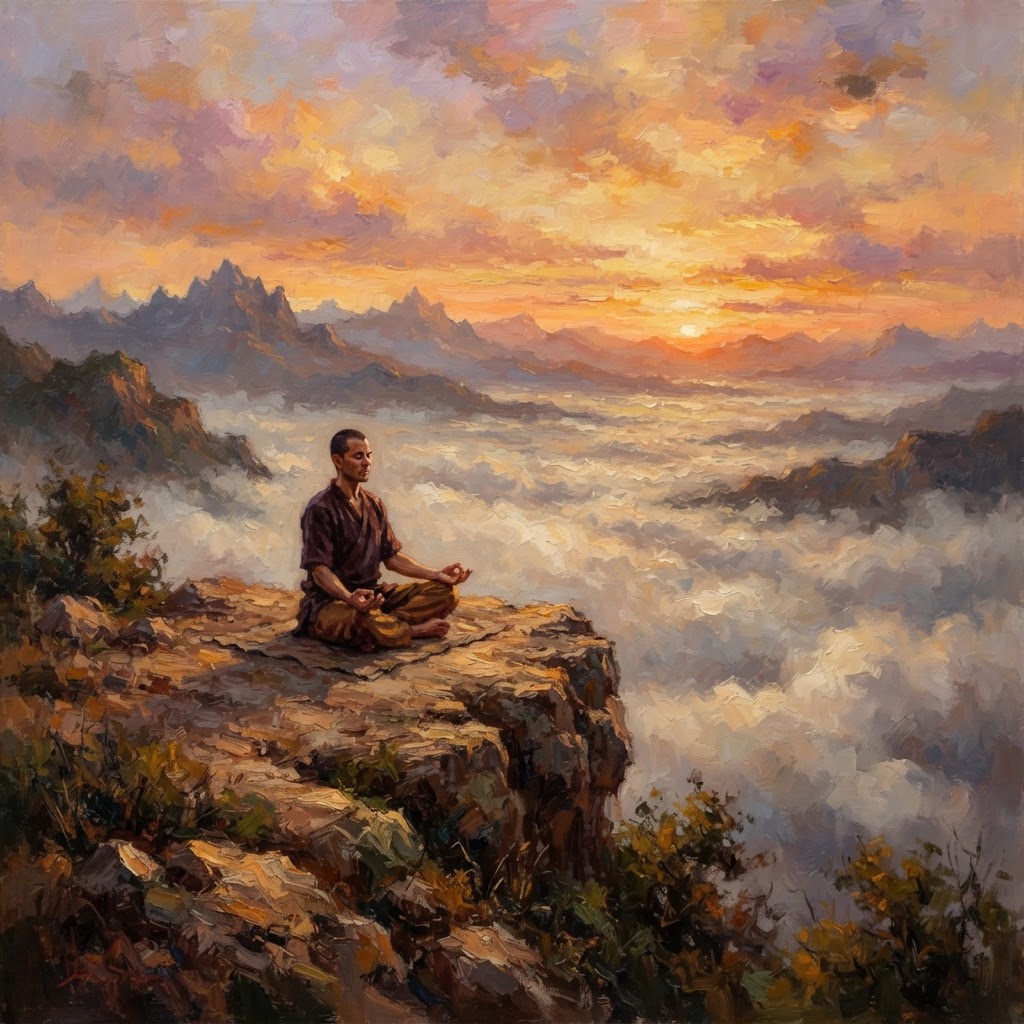
The Unvarnished Mirror: Milarepa's Courage to See Clearly
"As long as we are not kidding ourselves, then we can accomplish something. As long as we are kidding ourselves, we create spiritual materialism."
These words from Chögyam Trungpa, reflecting on the life of the great Tibetan yogi Milarepa, cut to the heart of what it means to truly engage with the spiritual path. Milarepa, a figure of immense spiritual realization, became "famous" not for seeking fame, but for his unwavering commitment to not lying to himself in his meditation practice. This, Trungpa Rinpoche suggests, is the bedrock upon which any genuine accomplishment is built.
In our modern lives, we are bombarded with distractions, pressures, and an endless stream of information. It's all too easy to fall into the trap of "kidding ourselves." This isn't about deliberate deception, but rather a subtle tendency to shield ourselves from what is uncomfortable, to gloss over our raw emotions, to intellectualize our experiences rather than feel them, or to pursue spiritual practice with an underlying agenda of self-improvement or seeking a specific outcome. This is what Trungpa Rinpoche termed "spiritual materialism" – the tendency to use spiritual concepts and practices as a means to enhance our ego, rather than to see through it.
Milarepa’s journey, as presented in "The Life and Example of Milarepa," was not a gentle one. He faced immense hardship and was initially on a path of vengeance before finding his teacher, Marpa Lotsawa. Marpa’s "ruthless" cutting through Milarepa's materialism and delusions, as described in the source material, wasn't an act of cruelty, but of profound compassion. It was the necessary unmasking, the stripping away of pretenses, that allowed Milarepa to enter the dharma cleanly. This challenging relationship highlights a core teaching: the duty of a teacher to help a student confront and overcome obstacles, including fixed views and expectations.
How does this translate to our daily practice on Beacon CRM or in our meditation cushions? It calls us to cultivate a similar kind of honesty. When we sit, are we truly present with whatever arises – boredom, restlessness, joy, or sorrow – without immediately trying to fix it, escape it, or label it as "good" or "bad"? Are we honest about our motivations for practicing? Are we willing to acknowledge our neuroses, our tendencies towards self-deception, without judgment but with clear awareness?
Milarepa's path shows that even the most difficult circumstances can be workable, that enlightenment is attainable within one lifetime. This potential rests on our willingness to meet ourselves with radical honesty. It means looking at our practice not as a means to an end, but as the end itself – a continuous, unfolding process of waking up. It's about embracing "straightforward discipline" and finding heroism not in external achievements, but in the quiet courage to be fully present with ourselves, just as we are.
Perhaps today, we can bring a touch of Milarepa's unvarnished mirror to our experience. What is one way we might choose not to kid ourselves, even in a small way? What might arise when we simply allow ourselves to be, without the need for spiritual pretense?
Source
This post draws from teachings in the Chögyam Trungpa Digital Library
"The Life and Example of Milarepa"